



Latest articles

Breaking boards’ “don’t ask, don’t tell” risk mindset with objectives-related risk assessments
A panel of thought leaders flag that linking risk management strategies to specific business objectives could prove pivotal in securing leadership investment for risk mitigations outside of compliance tick boxes
Register for free with StrategicRISK
Unlock full access to award-winning journalism tailored for senior risk professionals.
If you are already registered, please sign-in for access.
Latest articles
How cyber criminals are weaponising stolen corporate intelligence
Circuit overload: How hidden supply chain concentrations are putting businesses at risk
AI adoption outpaces governance as businesses struggle to close training gaps
Bank of America fined $1.21bn over longstanding failures in financial crime controls
French riots highlight the risks of widespread civil unrest
Ageing fleets. New solutions
Why unverified AI is becoming a compliance liability
Why Japan’s lean supply chains are proving a soft target for ransomware
The risk report now costs 19 cents, should risk management salaries be adjusted down?
How cyber criminals are weaponising stolen corporate intelligence
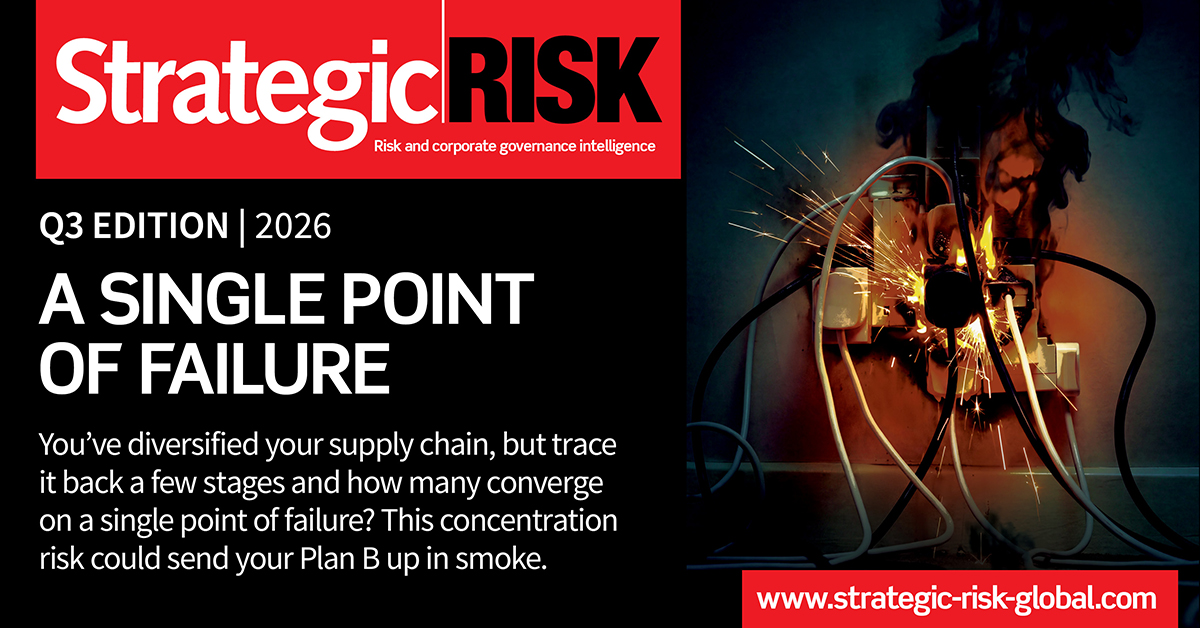
Circuit overload: How hidden supply chain concentrations are putting businesses at risk
AI adoption outpaces governance as businesses struggle to close training gaps
Bank of America fined $1.21bn over longstanding failures in financial crime controls













For commercial opportunities please contact:

Aisha Roberts
Commercial Director
+44 (0)20 7618 3408



Ageing fleets. New solutions
Facing escalating geopolitical tensions and climate conditions, the maritime industry faces increasing vulnerabilities to disruption. AI and data analytics are stepping in to support future transformation, says Alice Kwok.

Geopolitics, risk, and resilience
The meerkat has been managing an effective survival playbook for millennia. Kroll’s Steve Rumbold explores what today’s organisations can learn from it.

What lies beneath the calm waters of Asia’s E&P lines
The executive and professional lines market is offering its most favourable pricing in years – but beneath these softening conditions, global tension, rising insolvencies and digital enforcement are ever-harder to navigate. Smart buyers will use the moment to secure better cover with partners built to last, writes BHSI’s Scotland Walsh-Riddle.




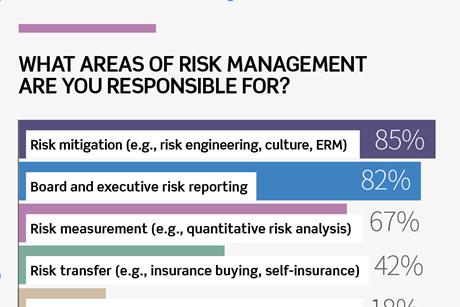
SR:500 survey results: Risk managers push for earlier influence as threats accelerate
The SR:500 Emerging Risks survey reveals a landscape dominated by accelerating and interconnected threats. Against this backdrop, risk management must be embedded earlier in decision making to strengthen resilience.
Breaking boards’ “don’t ask, don’t tell” risk mindset with objectives-related risk assessments
A panel of thought leaders flag that linking risk management strategies to specific business objectives could prove pivotal in securing leadership investment for risk mitigations outside of compliance tick boxes
In partnership with 

Why risk managers are turning to parametrics to solve operational challenges
As nat cats grow more severe, insurance gaps are widening - but parametric solutions might hold the key to resilience, says Dianna Nelson, a senior structurer at Swiss Re Corporate Solutions


- Forgotten Password
- Contributors
- Feedback
- Media Pack
- © StrategicRISK 2026
Part of the Insurance and Risk group of
Newsquest Specialist Media
Newsquest Specialist Media



Published by Newsquest Media Group Limited,
registered in England & Wales with number 01676637
at The Echo Building, 18 Albert Road, Bournemouth,
England, BH1 1BZ - a USA Today company
registered in England & Wales with number 01676637
at The Echo Building, 18 Albert Road, Bournemouth,
England, BH1 1BZ - a USA Today company
Site powered by Webvision Cloud